Body mass index is the most common health number in the world. It appears on doctors' charts, insurance forms and fitness apps, and it takes nothing more than your height and weight to produce. That simplicity is its great strength and, at the same time, the source of almost every misunderstanding about it. This guide explains what BMI genuinely tells you, where it quietly misleads, and which measurements fill the gaps it leaves.
What BMI actually measures
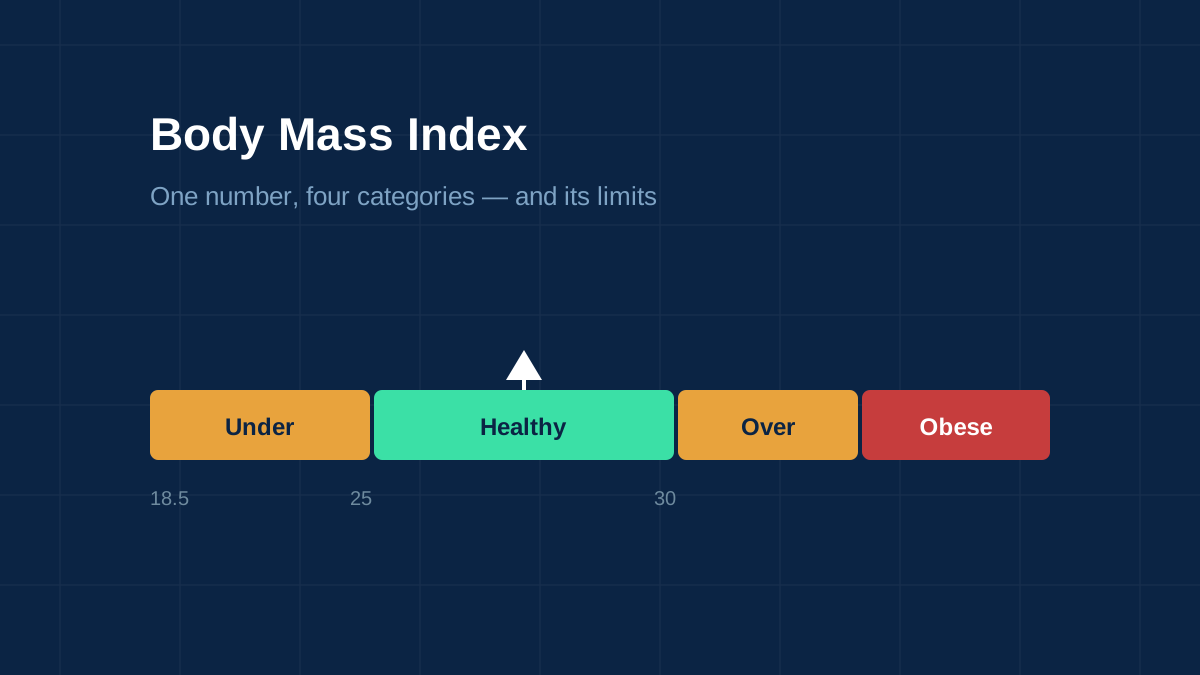
BMI divides your weight in kilograms by the square of your height in metres. The result sorts adults into bands: below 18.5 is underweight, 18.5 to 24.9 is a healthy weight, 25 to 29.9 is overweight, and 30 or above is obese. That is the whole calculation. It was devised in the nineteenth century by a Belgian mathematician who was trying to describe populations, not diagnose individuals, and that origin explains both what it is good at and what it is not.
Across a large group of people, BMI correlates reasonably well with body fat and with the health risks that come with carrying too much of it. That makes it genuinely useful for public health: it is cheap, needs no equipment, and flags trends across millions of people quickly. The trouble starts when a tool built for populations is used to judge one specific human being.
Why it misleads for muscular people
BMI cannot tell the difference between a kilogram of muscle and a kilogram of fat. Muscle is denser than fat, so a lean, heavily trained person carries more weight for their height than the equation expects. A rugby player or a serious weightlifter can land squarely in the overweight or even obese band while carrying very little fat and being in excellent health. The number is not lying about their weight; it is simply blind to what that weight is made of.
The same blind spot works in reverse. Someone can sit comfortably inside the healthy BMI range while carrying a high proportion of fat and very little muscle — sometimes called "normal weight obesity". Their BMI reassures them while the underlying picture is less rosy. In both cases the fix is the same: measure body composition, not just total mass.
Where the fat sits matters as much as how much
BMI says nothing about where fat is stored, and location carries real health consequences. Fat around the abdomen, packed around the internal organs, is more strongly linked to heart disease and type 2 diabetes than the same amount of fat on the hips and thighs. Two people with an identical BMI can therefore carry very different levels of risk depending on their shape.
This is why waist measurement is such a useful companion to BMI. A simple, well-supported rule of thumb is that your waist should measure less than half your height. Our body fat calculator uses waist, neck and height together to estimate body fat and reports the waist-to-height ratio alongside it, which catches much of what BMI misses.
It was not built for every body
Because BMI came from data on a fairly narrow population, its thresholds do not fit everyone equally. Several health bodies now use lower cut-offs for people of South and East Asian descent, because the health risks associated with excess weight appear at a lower BMI in those groups. BMI is also not validated during pregnancy, and it reads differently for older adults, who tend to lose muscle with age, and for very tall or very short people, where the squaring in the formula distorts the result slightly.
None of this makes BMI useless. It makes it a starting point that needs context. A BMI of 26 means something different for a 25-year-old athlete, a pregnant woman, and a frail 80-year-old, and no single chart can capture that.
Children are a separate case
For anyone under 20, BMI is not read against the fixed adult bands at all. Children's body composition changes rapidly as they grow, so their BMI is compared against age-and-sex percentile charts instead. A number that would be "overweight" for an adult may be perfectly normal for a growing teenager. If you are checking a child's BMI, use a paediatric percentile tool and, ideally, involve a healthcare professional rather than the adult categories.
What to measure alongside BMI
BMI works best as one reading among several. Three companions cover most of its blind spots. Waist circumference, or the waist-to-height ratio, catches dangerous abdominal fat that BMI ignores. Body fat percentage distinguishes muscle from fat, which BMI cannot do at all; the body fat calculator estimates it from tape measurements. And simply how you feel and function — energy, fitness, bloodwork from a doctor — tells you things no ratio of height to weight ever will.
If your goal is to change your weight, BMI is a reasonable way to set a broad target, but the day-to-day work happens through energy balance. Our calorie calculator estimates the daily intake to maintain, lose or gain weight, and the BMR calculator shows the energy your body uses at rest, which is the foundation those targets are built on.
Tracking change over time beats any single reading
A single BMI figure is a snapshot, and snapshots are easy to over-interpret. What tells you far more is the direction of travel. A BMI that has crept up two points over three years is a more useful signal than whether today's number sits at 24.8 or 25.1, on either side of an arbitrary line. Bodies also fluctuate day to day with water, food and timing, so a reading taken after a salty meal and a reading taken first thing in the morning can differ enough to shift a category without anything real having changed.
If you are using BMI to monitor your health, measure under the same conditions each time — same time of day, same scale, ideally the same day of the week — and pay attention to the trend across weeks and months rather than reacting to any one figure. The categories are useful as broad reference points, but a steady trend line is what actually reflects what is happening to your body. Combine that trend with a waist measurement taken the same way, and you have a picture that is far harder to misread than a lone number against a fixed threshold.
How to use your BMI sensibly
Treat BMI as a first look, not a verdict. If it falls in the healthy range and your waist measurement and general health back that up, it is doing its job. If it flags overweight or obese, take it seriously but check it against body composition and where your weight sits before drawing conclusions — especially if you are muscular. And if it flags underweight, that deserves attention too, since being under the healthy range carries its own risks. The number is a useful signpost. It was never meant to be the destination.