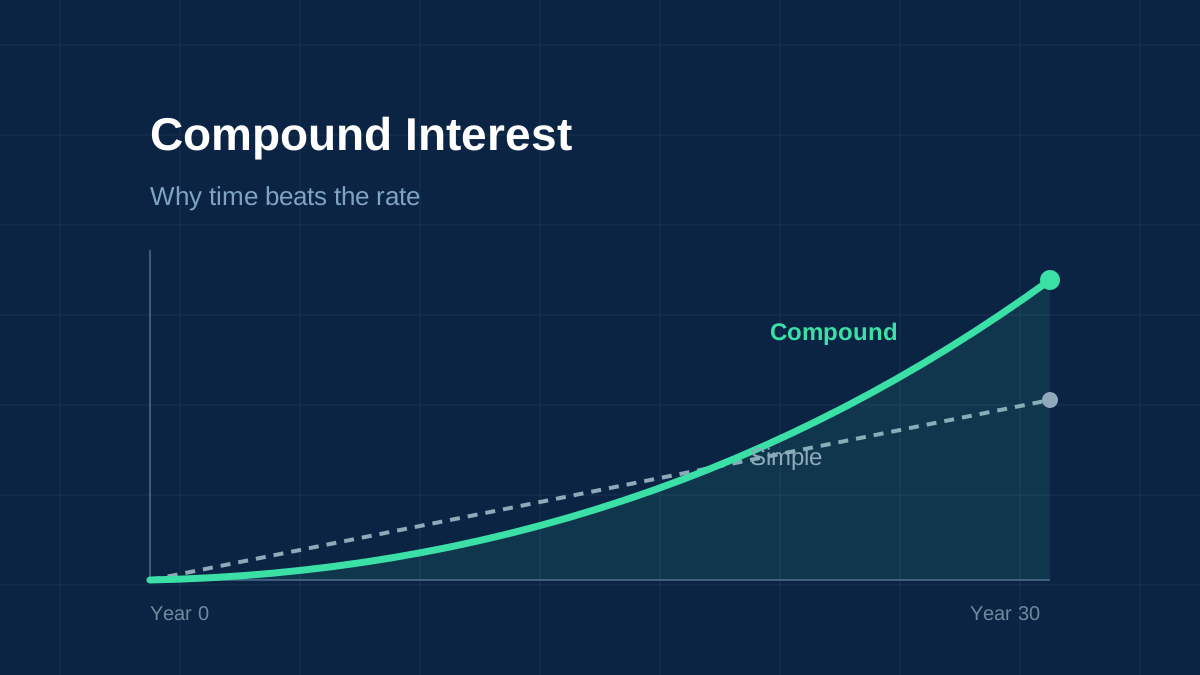
Compound interest is often called the most powerful force in personal finance, and while that is a cliche, it is close to true. It is the mechanism by which small, regular amounts of money grow into large ones given enough time, and it is also, working in reverse, the reason debt can spiral. Understanding it properly changes how you think about saving, borrowing and the single most valuable resource you have: time.
Simple interest versus compound interest
Simple interest pays you only on the money you originally put in. Put $10,000 somewhere paying 7% simple interest and you earn $700 every year, forever — $7,000 over ten years. Compound interest pays you on your original money and on the interest you have already earned. In the first year you still earn $700, but in the second year you earn 7% of $10,700, and in the third year 7% of that larger figure, and so on. Each year's interest joins the pile that earns next year's interest.
That small difference, repeated over many years, is enormous. At 7% compound, $10,000 grows to about $19,700 in ten years, not $17,000. The extra $2,700 is interest earned on interest — money that appeared from nothing but time.
Why time matters more than the rate
Most people, offered the choice, would chase a higher interest rate. But over long periods, time is usually the more powerful lever, and it is the one more within your control. Consider $10,000 left to compound at 7%. After 20 years it is worth about $38,700. After 30 years it is about $76,100. That third decade nearly doubled the result, with no extra deposits, no extra risk and no cleverness — just ten more years.
This is why the most repeated piece of investing advice is to start early. A 25-year-old who invests a modest amount and stops at 35 often ends up ahead of a 35-year-old who invests the same amount every year until 65, because the early money had decades longer to compound. The years at the start, when the balance is small and progress feels invisible, are quietly doing the heaviest lifting. Our compound interest calculator lets you change the number of years and watch this effect directly.
The rule of 72
There is a quick mental shortcut for compound growth called the rule of 72. Divide 72 by your annual return and you get the rough number of years it takes to double your money. At 8%, that is 72 divided by 8, or about nine years. At 6% it is twelve years. It is only an approximation, but it is a fast way to sense-check any investment claim: if someone promises to double your money in two years, the rule of 72 tells you they are implying a 36% annual return, which should make you deeply suspicious.
Regular contributions change the picture
A lump sum compounding on its own is powerful, but adding money regularly is what turns compound interest into real wealth for most people. Each contribution starts its own compounding journey, and the ones you make early have the most time to grow. A steady monthly amount, automated so it happens before you can spend it, harnesses both the discipline of regular saving and the mathematics of compounding at once.
The effect is striking. Ten thousand dollars left alone at 7% for 30 years becomes about $76,000. Add just $300 a month over the same period and the total climbs past $430,000 — and of that, well over half is growth rather than the money you put in. The compound interest calculator shows this split between what you contributed and what the interest added, which is often the most motivating number of all.
What fees quietly take
Compounding works on whatever return you actually keep, and fees come off the top before compounding happens. A fee that sounds trivial — say 1% a year — is devastating over decades, because it does not just cost you 1%; it costs you the compound growth that 1% would have earned every year for the rest of the investment's life. Over 30 years, a 1% annual fee can consume roughly a quarter of your final balance. When you compare funds or platforms, subtract the fee from the return before you run any projection, so you are modelling what you will really receive.
Inflation and the difference between nominal and real
A projection that shows your money growing to a large number is showing nominal growth — the raw figure, before accounting for rising prices. If inflation runs at 3% a year, a 7% return is closer to 4% in terms of what your money can actually buy. That does not make the growth fake, but it does mean the future figure buys less than the same number would today. To see growth in today's buying power, enter your expected return minus expected inflation into the calculator. It is a more honest, if less exciting, picture.
The same force works against you in debt
Everything that makes compound interest wonderful when you are saving makes it dangerous when you are borrowing. Credit card debt compounds against you, often at rates above 20%, so an unpaid balance grows the same way an investment does — just in the wrong direction. This is why clearing high-interest debt is frequently the best "investment" anyone can make: paying off a card charging 20% is a guaranteed 20% return, which no ordinary investment can promise. The same logic drives our guide to comparing mortgages, where total interest matters far more than the headline rate. The mortgage and loan calculators show how much of your payments go to interest over time, which is compounding seen from the borrower's side.
Putting it to work
The practical lessons are simple, even if the mathematics is not. Start as early as you can, because time is the ingredient you cannot buy back. Contribute regularly and automatically, so the habit does not depend on willpower. Keep fees low, because they compound against you. Judge growth in real terms, after inflation. And treat high-interest debt as an emergency, because it is compounding running in reverse. Use the compound interest calculator to test your own numbers, and the savings goal calculator to work out the monthly amount that reaches a target by a date you choose.